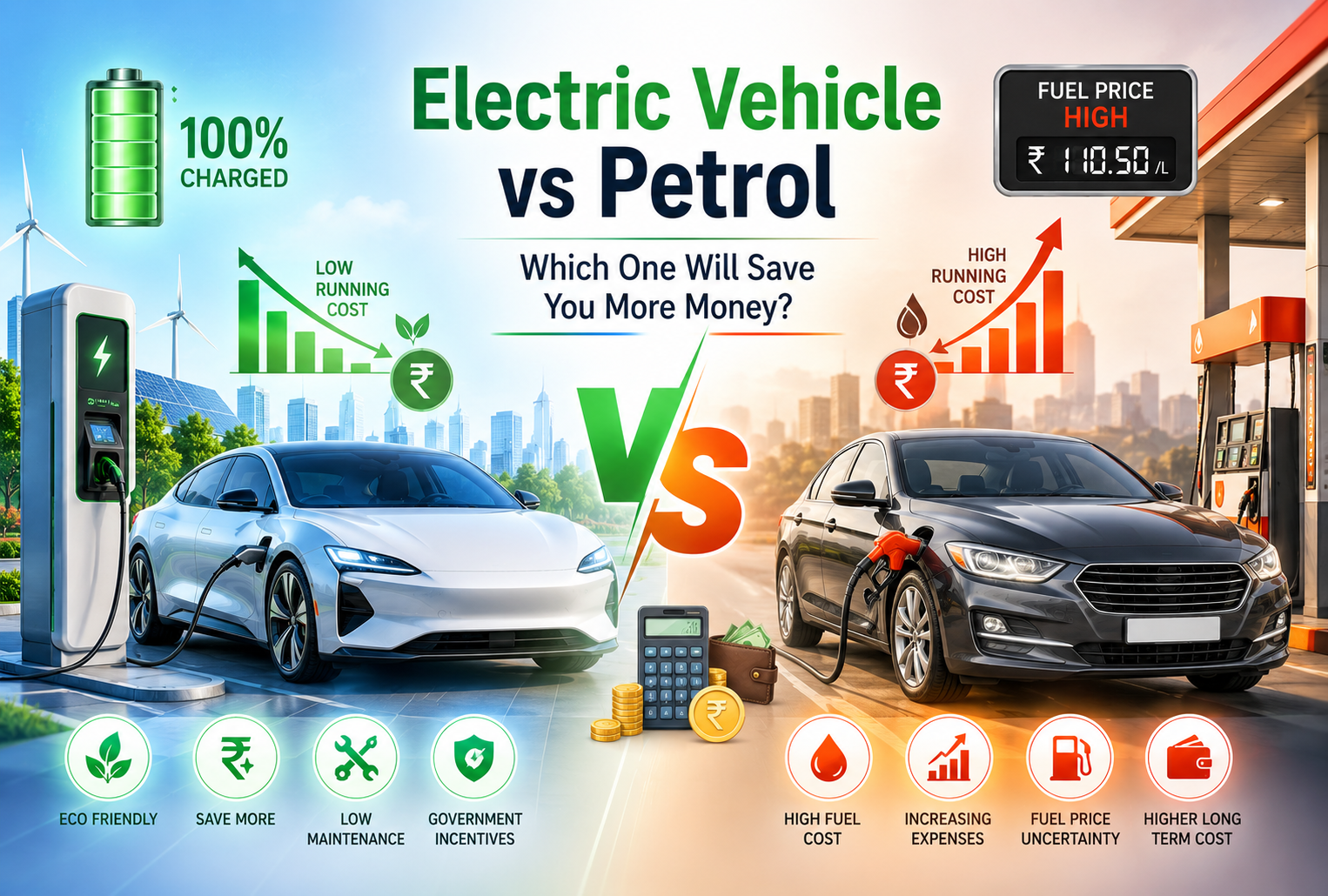
The debate between Electric Vehicle vs Petrol cars has become one of the biggest topics among car buyers. With rising fuel prices and increasing awareness of sustainable transportation, many people are wondering whether an electric vehicle (EV) can actually save more money than a traditional petrol car.
While electric vehicles often have a higher purchase price, they offer lower running and maintenance costs. Petrol vehicles, on the other hand, are generally cheaper to buy initially but can become expensive over time due to fuel and servicing expenses.
In this guide, we’ll compare Electric Vehicle vs Petrol cars based on purchase cost, fuel expenses, maintenance, government incentives, and long-term ownership costs to help you make the right financial decision.
Understanding Electric Vehicles and Petrol Cars
What Is an Electric Vehicle?
An electric vehicle runs entirely on electricity stored in rechargeable batteries. EVs use electric motors instead of internal combustion engines and produce zero tailpipe emissions.
Popular EVs in India include:
- Tata Nexon EV
- Mahindra BE 6
- MG Windsor EV
What Is a Petrol Vehicle?
Petrol cars use an internal combustion engine powered by gasoline. They remain the most common vehicle type due to their widespread fuel infrastructure and lower upfront cost.
Popular petrol vehicles include:
- Maruti Suzuki Swift
- Hyundai Creta
- Honda City
Purchase Cost Comparison
| Factor | Electric Vehicle | Petrol Vehicle |
| Initial Price | Higher | Lower |
| Registration Benefits | Often available | Limited |
| Government Incentives | Available in some regions | Rare |
| Financing Options | Growing rapidly | Widely available |
At first glance, petrol vehicles appear more affordable because EV batteries significantly increase manufacturing costs. However, the higher purchase price can often be offset through lower operating expenses over time.
Fuel Cost Comparison
One of the biggest advantages of EVs is lower energy cost.
Petrol Car Example
Assume:
- Daily driving: 50 km
- Mileage: 15 km/l
- Petrol price: ₹105/litre
Daily fuel cost:
- 50 ÷ 15 = 3.33 litres
- 3.33 × ₹105 = approximately ₹350/day
Monthly cost:
- Around ₹10,500
Electric Vehicle Example
Assume:
- Daily driving: 50 km
- Energy consumption: 15 kWh per 100 km
- Electricity cost: ₹8/kWh
Daily charging cost:
- Around ₹60
Monthly cost:
- Around ₹1,800
Winner: Electric Vehicle
In most cases, EV charging costs are significantly lower than petrol expenses, resulting in substantial annual savings.
Maintenance Cost Comparison
Maintenance is another major area where EVs generally outperform petrol cars.
Electric Vehicle Maintenance
EVs have:
- Fewer moving parts
- No engine oil changes
- No clutch replacement
- Reduced brake wear due to regenerative braking
Common maintenance includes:
- Tire replacement
- Battery checks
- Software updates
Petrol Vehicle Maintenance
Petrol cars require:
- Engine oil changes
- Filter replacements
- Spark plug servicing
- Exhaust system maintenance
- Clutch and gearbox repairs
Winner: Electric Vehicle
Most EV owners spend considerably less on annual maintenance.
Long-Term Ownership Cost
Let’s compare a five-year ownership period.
| Expense | Electric Vehicle | Petrol Vehicle |
| Purchase Cost | Higher | Lower |
| Fuel/Energy | Much Lower | Higher |
| Maintenance | Lower | Higher |
| Total Running Cost | Lower | Higher |
Although EVs may cost more initially, their lower running costs can result in significant savings over several years.
Charging Infrastructure vs Fuel Availability
Electric Vehicle
Pros:
- Home charging convenience
- Growing public charging network
- Lower operating cost
Cons:
- Charging infrastructure still expanding
- Charging takes longer than refueling
Petrol Vehicle
Pros:
- Fuel stations widely available
- Quick refueling
Cons:
- Higher ongoing fuel expenses
For city users, EV charging is becoming increasingly convenient.
Environmental Impact
Electric vehicles produce zero tailpipe emissions and help reduce urban air pollution.
Benefits include:
- Lower carbon emissions
- Reduced noise pollution
- Improved energy efficiency
Petrol vehicles continue to emit:
- Carbon dioxide (CO₂)
- Nitrogen oxides
- Other pollutants
If sustainability matters to you, EVs offer a clear advantage.
Who Should Buy an Electric Vehicle?
An EV is ideal if you:
- Drive regularly within cities
- Have access to home charging
- Want lower running costs
- Plan to keep the vehicle for several years
- Want an environmentally friendly option
Who Should Buy a Petrol Vehicle?
A petrol car may still be suitable if you:
- Frequently travel long distances
- Live in areas with limited charging infrastructure
- Need a lower initial purchase cost
- Prefer faster refueling
Electric Vehicle vs Petrol: Final Verdict
When comparing Electric Vehicle vs Petrol cars purely from a cost-saving perspective, electric vehicles generally offer better long-term value. While the upfront investment may be higher, the savings on fuel and maintenance can outweigh the initial price difference over time.
For urban commuters and daily drivers, EVs can significantly reduce monthly transportation expenses. Petrol vehicles remain a practical choice for buyers prioritizing lower purchase prices and extensive travel flexibility.
As charging infrastructure continues to expand across India, electric vehicles are becoming an increasingly attractive and economical alternative to traditional petrol cars.
FAQs
1. Is an electric vehicle cheaper than a petrol car?
EVs are usually more expensive to buy but often cheaper to own and operate over the long term.
2. Which has lower maintenance costs?
Electric vehicles generally have lower maintenance costs because they have fewer moving parts.
3. Are EV charging costs lower than petrol costs?
Yes. Charging an EV typically costs much less than fueling a petrol vehicle for the same distance.
4. How long does it take for EV savings to offset the higher purchase price?
For many drivers, the difference can be recovered within a few years through fuel and maintenance savings.
5. Are electric vehicles suitable for long-distance travel?
Yes, but route planning may be required depending on charging infrastructure availability.