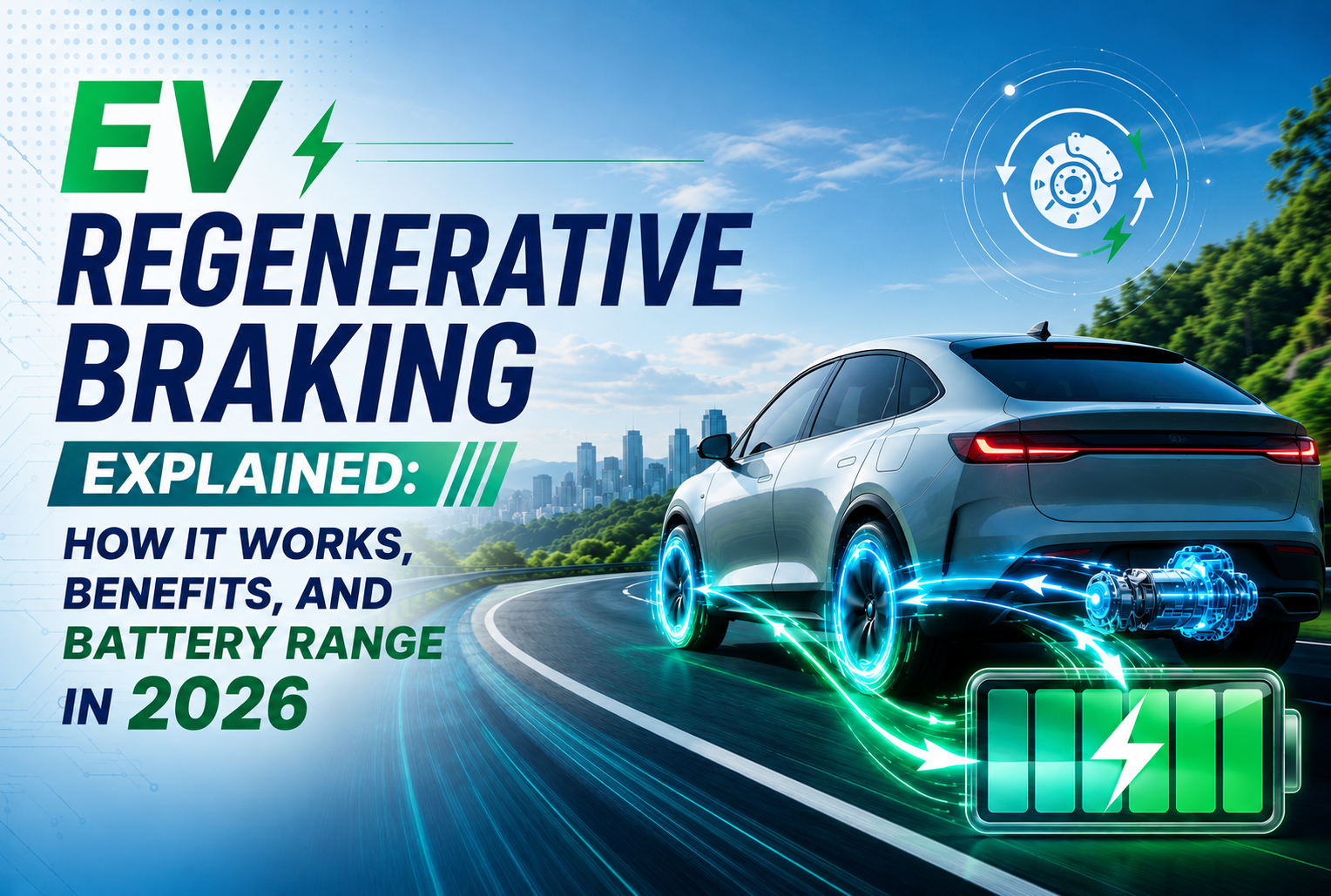
Electric vehicles (EVs) are changing the way we think about transportation. Beyond producing zero tailpipe emissions and offering lower running costs, EVs are equipped with advanced technologies that improve efficiency and extend driving range. One of the most important of these innovations is EV Regenerative Braking.
Unlike traditional braking systems that waste energy as heat, regenerative braking captures a portion of that energy and sends it back to the battery. This process helps improve efficiency, reduce brake wear, and increase the overall driving range of an electric vehicle.
In this guide, you’ll learn how EV Regenerative Braking works, its key advantages, common limitations, and why it has become a standard feature in almost every modern EV in 2026.
What Is EV Regenerative Braking?
EV Regenerative Braking is a system that recovers kinetic energy generated while a vehicle slows down. Instead of allowing this energy to dissipate as heat through conventional friction brakes, the electric motor operates in reverse and acts as a generator.
As the vehicle decelerates, the motor converts the wheels’ rotational energy into electricity. That electricity is then sent back to the battery, where it can be stored and reused to power the vehicle.
This process improves energy efficiency and reduces unnecessary energy loss, making electric vehicles significantly more efficient than conventional petrol or diesel cars.
How Does EV Regenerative Braking Work?
When an electric vehicle is accelerating, the battery supplies electricity to the motor, which turns the wheels.
However, when the driver releases the accelerator or presses the brake pedal, the process changes.
Instead of consuming electricity, the electric motor begins generating electricity. The wheels continue spinning due to the vehicle’s momentum, causing the motor to rotate. The motor then converts this mechanical energy into electrical energy and feeds it back into the battery.
This recovered energy can later be used to power the vehicle, reducing the amount of electricity needed from external charging.
The result is a more efficient driving experience with less wasted energy.
Regenerative Braking vs Traditional Braking
Traditional braking systems rely entirely on friction. Brake pads press against brake discs, creating friction that slows the vehicle. While effective, this process converts valuable kinetic energy into heat, which is lost to the environment.
Regenerative braking works differently by recovering a portion of this energy and storing it for future use. Conventional friction brakes are still used during emergency stops, very low speeds, or when stronger braking force is required, but regenerative braking handles much of the routine deceleration during everyday driving.
This combination provides both safety and improved efficiency.
Key Benefits of EV Regenerative Braking
Increases Driving Range
One of the biggest advantages of EV Regenerative Braking is its ability to extend driving range.
Every time the vehicle slows down, a portion of the energy that would normally be wasted is recovered. While regenerative braking doesn’t fully recharge the battery, it can noticeably improve efficiency, especially in urban driving conditions with frequent stops.
For many EV owners, this translates into fewer charging sessions and lower electricity costs over time.
Improves Energy Efficiency
Electric vehicles already use energy more efficiently than internal combustion engine vehicles, and regenerative braking enhances this advantage even further.
By recycling kinetic energy during deceleration, the vehicle makes better use of the electricity stored in its battery, increasing overall efficiency.
Reduces Brake Wear
Since regenerative braking performs much of the slowing during normal driving, traditional brake pads and brake discs are used less frequently.
This leads to:
- Longer brake pad life
- Reduced brake maintenance
- Lower servicing costs
- Improved long-term reliability
Many EV owners replace brake pads far less often than owners of petrol-powered vehicles.
Lower Maintenance Costs
Because there are fewer mechanical components under stress, regenerative braking contributes to lower maintenance expenses throughout the life of the vehicle.
Combined with the absence of engine oil changes, exhaust repairs, and transmission servicing, EV ownership becomes considerably more affordable.
Better Driving Experience
Many modern electric vehicles support one-pedal driving, where lifting your foot off the accelerator automatically slows the vehicle through regenerative braking.
This feature provides smoother driving in traffic while reducing the need to constantly move between the accelerator and brake pedal.
Does Regenerative Braking Fully Charge the Battery?
A common misconception is that regenerative braking can completely recharge an electric vehicle’s battery.
In reality, the system only recovers a portion of the energy generated during deceleration. The recovered electricity helps improve efficiency and extend range but cannot replace regular charging.
Drivers will still need to charge their vehicles using home chargers, workplace charging stations, or public fast chargers.
Factors That Affect Regenerative Braking Performance
The effectiveness of regenerative braking depends on several factors.
Battery state of charge plays an important role. If the battery is already close to full capacity, the system may limit energy recovery to protect battery health.
Vehicle speed also affects performance. More kinetic energy is available at higher speeds, allowing greater energy recovery during deceleration.
Driving conditions matter as well. Urban environments with frequent stop-and-go traffic generally provide more opportunities for regenerative braking than long highway journeys with consistent speeds.
Temperature can also influence system efficiency, as extremely cold or hot weather may reduce battery performance.
Can Drivers Adjust Regenerative Braking?
Many modern electric vehicles allow drivers to customize the level of regenerative braking.
Some vehicles offer multiple settings ranging from light regeneration to aggressive one-pedal driving.
Higher settings maximize energy recovery and reduce reliance on conventional brakes, while lower settings provide a driving experience that feels more like a traditional petrol vehicle.
This flexibility allows drivers to choose the braking behavior that best suits their preferences and road conditions.
Are There Any Limitations?
Although regenerative braking offers numerous benefits, it does have some limitations.
It cannot provide the full braking force needed during emergency stops, which is why conventional hydraulic brakes remain an essential safety component.
Energy recovery also decreases when the battery is fully charged or operating under extreme temperatures.
Despite these limitations, regenerative braking remains one of the most effective technologies for improving electric vehicle efficiency.
Why Regenerative Braking Is Important in 2026
As battery technology continues to improve, manufacturers are focusing on increasing efficiency rather than simply increasing battery size.
Regenerative braking plays a critical role in this strategy by maximizing the energy already available within the vehicle.
Combined with lighter vehicle designs, improved battery chemistry, and smarter energy management systems, regenerative braking helps modern EVs travel farther without requiring larger battery packs.
This makes electric vehicles more practical, affordable, and environmentally friendly.
Conclusion
EV Regenerative Braking is one of the defining technologies behind the success of modern electric vehicles. By converting braking energy into usable electricity, it improves driving efficiency, extends battery range, reduces brake wear, and lowers maintenance costs.
Although it cannot completely recharge an EV’s battery, regenerative braking significantly contributes to overall vehicle efficiency, especially during city driving.
As electric vehicles continue to evolve in 2026, regenerative braking will remain a key innovation that helps drivers travel farther, spend less on maintenance, and enjoy a smoother, more sustainable driving experience.